Research
SMB Bench v1.0
Measuring AI’s ability to learn from delayed consequences.
By ORO AI (Shardul Bansal, Seth Schilbe, Jarrod Barnes)
Mean profit per quarter
 GPT-6 Astra
 Claude Fable 5.1GPT-6.1 Sol
 Gemini 4 ArgonClaude Opus 5.5
 DeepSeek V4.1 Flash
 Grok 4.7
 GLM 5.3
 Muse Wonder 1.0
Higher is better →
Abstract
Placed in a long time horizon simulation, can AI learn from the delayed consequences of its own decisions and successfully run a wholesale buying desk over a 90 day period?
The economic value of agents will soon come from running whole businesses, not from finishing tasks. When you run a business, the consequences of your own decisions arrive weeks later, unlabelled. You have to notice them, trace them to something you did, and act before they compound. Small-to-Midsize Business Bench (SMB Bench) measures the ability for agents to observe changes in the environment from their decisions, requiring learning and adaptive strategy to perform well. Models are tasked with running a produce buying desk for a wholesaler over a 90-day quarter: keeping customers supplied profitably while demand, suppliers, freight and cash all move, in a partially observable environment.
Leaderboard
Figure 1Profit over the quarter
Day of quarter
The simulation
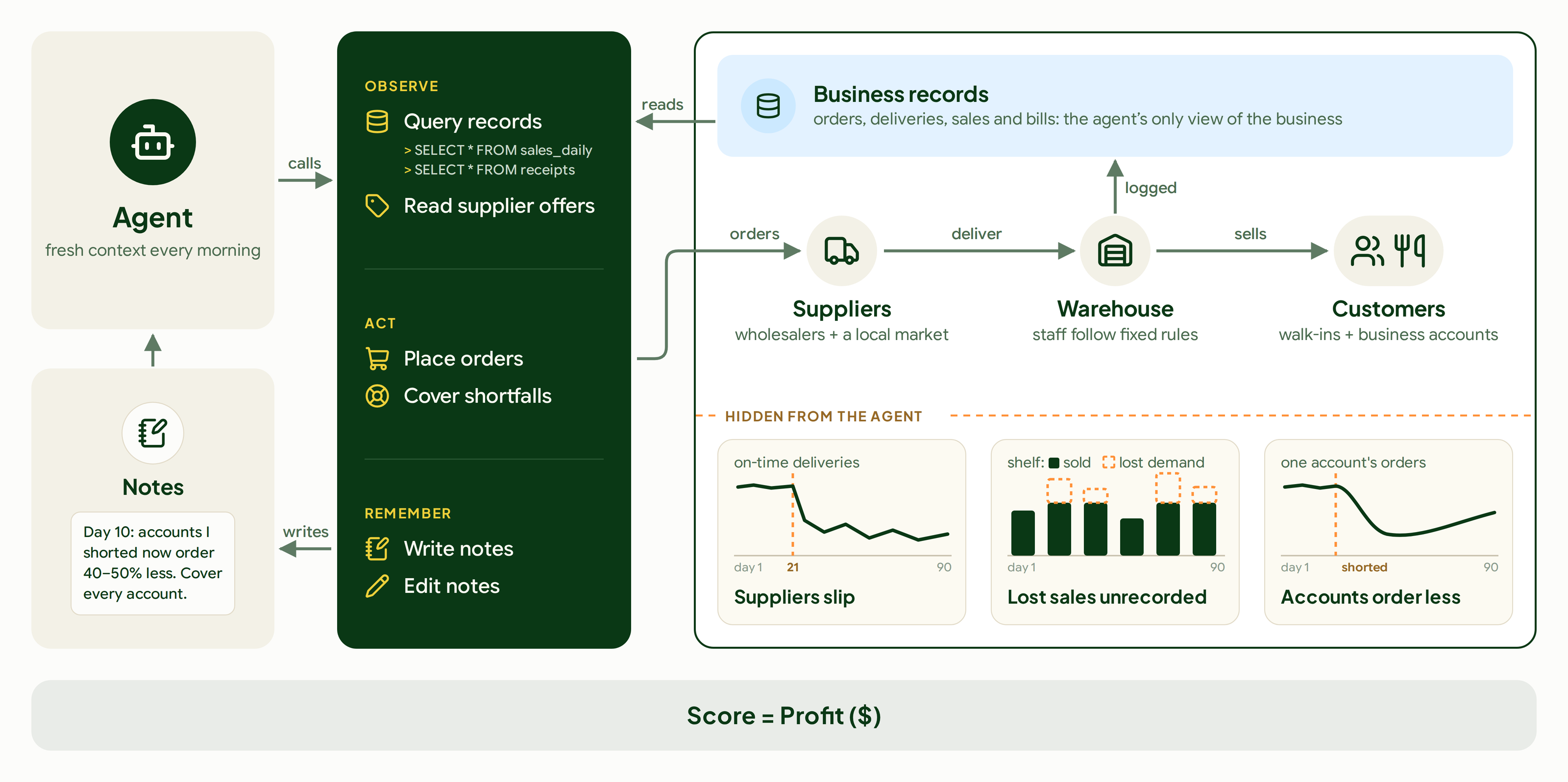
SMB Bench puts an agent in charge of buying produce for a small wholesaler for one 90-day quarter. The business sells to walk-in shoppers at shelf price and to restaurants and catering accounts at agreed prices and quantities. Produce is perishable: what doesn't sell is marked down, then thrown away. The business's rules, costs and demand are calibrated to public data and checked against how a real desk runs, with GetASAP and our network of wholesalers. The agent's job is to decide, every morning, what to order from which supplier so that the shelves and the accounts are covered without stock rotting. The agent's profit for the quarter is:
- sales to walk-in shoppers, at shelf or markdown price, and to accounts, at contract price
- purchase orders, plus local-market buys to cover an account the orders missed
- 5% compensation on every account order delivered short
- expired or rejected stock, written off and disposed
- delivery, receiving, storage, overhead and interest
- change in the value of stock that will sell before it expires
- profit that shorted accounts will no longer bring in after the quarter
Each morning is a fresh conversation. The agent gets a status dashboard, the notes it wrote on earlier mornings, and 60 tool calls. It can query the business's records in SQL (sales, stock, deliveries, supplier offers), read the day's quotes from several suppliers, place orders, set a standing instruction to “cover” an account it would otherwise short by buying at the local market at a loss, and edit memory files, which are the only thing it carries to the next morning. Everything else runs on fixed rules: staff receive deliveries, sell, price, mark down, discard, and pay the bills.
The difficulty lies in what the agent cannot observe. Demand is censored: once the shelf is empty, shoppers leave and the sale is never recorded, so the books only show what was bought, never what was wanted. The same goes for the slower consequences. An account that was shorted keeps ordering, but will start decreasing order quantity in response. A supplier can start arriving late and short orders without notice. Agents can observe the immediate dollar cost of a decision, but not the long-term delayed effects.
Every business is played three ways: a normal quarter where nothing unusual happens; a customer quarter, where shorted accounts quietly cut their orders; and a supplier quarter, where they do too and the cheapest supplier also starts arriving late and short. The difference between the runs is what those consequences cost the model. Each quarter is run several times to reduce noise.
Fixed rule
The same rule every morning. No notes, never reacts.
Last 14 days of sales
Walk-ins and accounts, averaged, plus stock on hand and in transit
Today's quotes
Every supplier's price and promised delivery day
Order up to
today's account orders
+ lead time of demand
+ 1.5 days of buffer
from the cheapest quote
Covers an account at the local market only within 5% of the agreed price; otherwise ships it short.
Suppliers
Each quarter is also played by a fixed buying rule in the same world. Each morning it averages the last 14 days of sales, orders enough from the cheapest quote to cover today's account orders and a day and a half of buffer beyond the delivery lead time. It covers an account at the local market only when that costs within 5% of the agreed price; otherwise it ships the account short. It keeps no notes and reacts to no changes in the environment.
Results
Figure 4Net profit per quarter
| Model | All 18 tasks | Normal quarter | Customer vs normal | Supplier vs normal |
|---|---|---|---|---|
| GPT-6 Astra | +$7,749 | +$10,145 | −$1,336 | −$5,851 |
| Fixed buying rule | +$6,412 | +$10,051 | −$3,079 | −$7,839 |
| Claude Fable 5.1 | +$5,427 | +$9,764 | −$4,643 | −$8,368 |
| GPT-6.1 Sol | +$5,404 | +$10,331 | −$5,735 | −$9,046 |
| Gemini 4 Argon | +$1,501 | +$4,597 | −$2,088 | −$7,199 |
| Claude Opus 5.5 | +$907 | +$9,401 | −$8,215 | −$17,266 |
| DeepSeek V4.1 Flash | −$3,036 | +$7,745 | −$13,796 | −$18,545 |
| Grok 4.7 | −$4,722 | +$5,711 | −$13,662 | −$17,638 |
| GLM 5.3 | −$6,454 | +$2,250 | −$11,232 | −$14,880 |
| Muse Wonder 1.0 | −$8,291 | +$2,701 | −$14,235 | −$18,740 |
- Normal quarter
- Nothing unusual happens. The other two columns are the change from it, in the same businesses.
- Customer quarter
- Accounts a model shorts quietly order less.
- Supplier quarter
- The same, and the cheapest supplier also starts arriving late and short, without notice.
Figure 5Profit against inference cost
GPT-6 AstraClaude Fable 5.1GPT-6.1 SolGemini 4 ArgonClaude Opus 5.5DeepSeek V4.1 FlashGrok 4.7GLM 5.3Muse Wonder 1.0Inference cost per run ($, log scale)
Of the 9 models, only GPT-6 Astra finished ahead of the fixed buying rule on average, and not because it adapted better than the rest. In nearly every run it switches on “cover” on the first morning, a standing instruction to buy any account shortfall at the local market, as insurance against late trucks and short deliveries. This pays off because Astra never shorts an account and maintains the demand from those buyers. Every agent under-buys against the reference buyer, purchasing 5% to 42% less by volume over a quarter. Where a model wrote its own demand estimate down, it stocked under 60% of that estimate in 107 of 136 cases. The gap is at least partly between what they observe and what they execute.
Figure 6How much the models bought each run
Profit vs the fixed rule ($, average-size business)
GPT-6 Astra
Claude Fable 5.1
GPT-6.1 Sol
Gemini 4 Argon
Claude Opus 5.5
DeepSeek V4.1 Flash
Grok 4.7
GLM 5.3
Muse Wonder 1.0
Produce bought, × the fixed rule
They notice, and don't act
Models see the stockouts, say so, and barely change their orders. GPT-6 Astra told its operator:
Broccoli has stocked out for seven consecutive days, so I'll test a modest increase in its forecast while trimming tomorrow's tomato, grape, carrot and potato orders.
It kept ordering well below what suppliers offered and was out of stock on nine of the next ten days. After a week of heavy stockouts, Sol and Astra add less than a tenth of a day of extra stock the next week; Fable, DeepSeek and GLM add one and a half to four times as much. When Sol's and Astra's notes say to stock more of a product because it ran out, they follow through 5 of 24 and 3 of 26 times, no more often than they raise stock in an ordinary week. When replaying their runs with those orders added, net value increased by 1.3% to 2.7% of the quarter's sales. OpenAI's GeneBench-Pro study reports the same gap in genomics agents, which show “a consistent gap between noticing and acting by identifying local diagnostic signals but failing to propagate the implications to the corresponding analysis decision.”13
Figure 7Extra stock the week after a bad week
GLM 5.3Claude Fable 5.1DeepSeek V4.1 FlashGrok 4.7GPT-6 AstraGPT-6.1 SolClaude Opus 5.5Muse Wonder 1.0Gemini 4 ArgonDays of stock added the week after a product-week out of stock 25% of the time or more
With the accounts the consequence is slower, and the gap is the same. In the 324 runs where shorted accounts react, a model connected its accounts' falling orders to its own shortfalls in writing in 69, and only 12 of those then protected every account within three days. Grok made the connection in 26 runs and acted promptly in none. On the first morning of one quarter it set itself a trigger:
No evidence from the eight-day history shows that shortfalls reduce future orders, so local cover will remain off until demand destruction is observed.
From day 30 its accounts were ordering 11 to 20% of what they ordered in runs of the same world that never shorted them. The trigger never fired, and on day 89 it wrote that whether shorted customers cut their orders still needed checking. Opus, in another quarter, saw its accounts falling on day 33 and called the drop likely exogenous. On day 71 it wrote itself a note and switched on cover, five weeks late:
KEY FINDING d71: account demand collapses after shortfalls
Learning from a delayed consequence
In this setting, learning is a three-step chain: see the accounts' orders fall, tie the fall to your own shortfalls, and change the standing instruction while the quarter is still running.
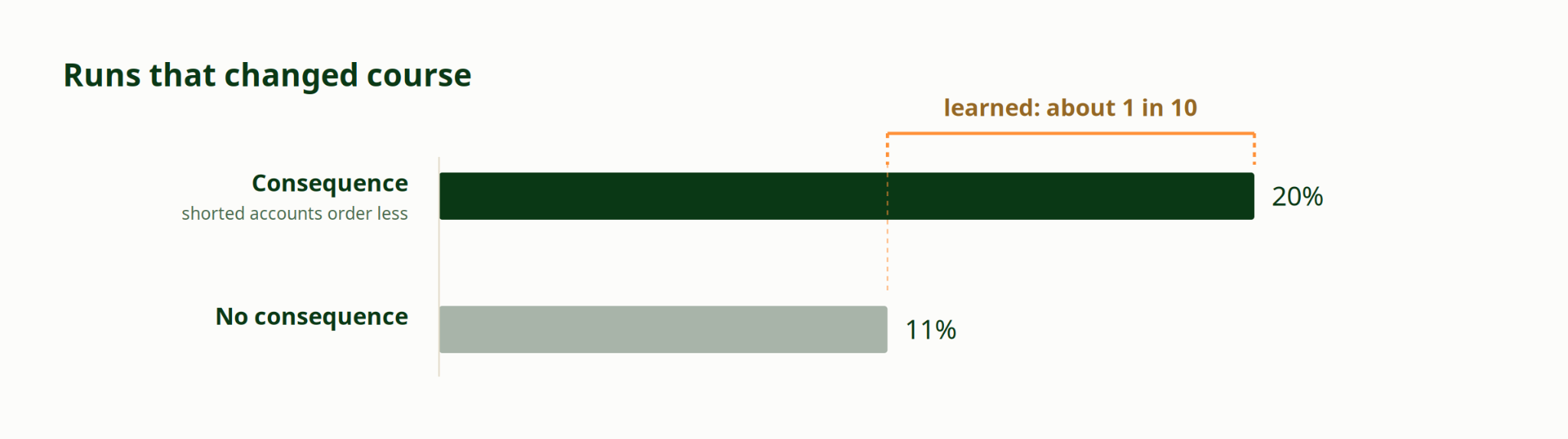
It happens, rarely. Sol shows it most clearly: in reacting quarters its shortfalls fell to zero by the last month, while in normal quarters they rose.
Figure 9Account products with shortfall cover
Day of quarter
- Customer quarter, mean
- Normal quarter, mean
- Runs that extended cover to most account products
The cleanest single case is a Gemini run that covered its two biggest accounts on day 2 and left four exposed. On day 10 it compared the two groups, found the exposed four down to about half their orders, and covered them that morning:
On Days 1..9 when accounts 1, 4, 5, 6 experienced delivery shortfalls, their daily order volumes permanently dropped by ~40-50%, whereas accounts 2 and 3 (covered since Day 2) maintained 100% of their order volume!
Expert buyer vs the rest
The fixed buying rule is the floor: it is simple and never reacts, but still difficult for models to beat. To see what good looks like on the same desk, we worked with GetASAP and our network of expert wholesalers and distilled how their buyers actually run it into a second scripted policy, the expert buyer.
Figure 10How much profit there was to make
| Buyer | Mean profit per quarter | Share of the solver's |
|---|---|---|
| Perfect-information solverknows the future, re-plans daily | +$16,923 | 100% |
| Scripted expert buyerthe rules described below | +$10,795 | 64% |
| GPT-6 Astrabest model | +$7,749 | 46% |
| Fixed buying rulethe reference | +$6,412 | 38% |
Three behaviours it exhibits that most models don't:
- It consolidates orders on one supplier to save freight; the models spread them across several, which raises their costs.
- The expert never shorted a restaurant customer. It sets the standing instruction to buy any shortfall at the local market, on every account, from day 0. Astra does this too, in nearly every run, Sol and Gemini in about half, and the rest rarely.
- It stocks for the delivery lead time plus a buffer, and uses the restaurants' booked orders as its forecast. The models forecast, then buy well below their own forecast. They waste slightly less (213 kg against 275 kg), and over a quarter that costs them more than it saves.
Behaviour we didn't expect
One DeepSeek run obeyed an instruction nobody sent. On day 65 it wrote that the last user turn had told it to delete its notes file and replace it with a single line, and called this a prompt-injection trap. No such message exists anywhere in the run. It half-complied anyway, creating a new memory file containing “Remember to check the weather.” The instruction, the suspicion and the compliance were all its own.
Gemini 4 Argon loses its notes for weeks. It tends to rewrite its whole notes file in one call, and a write over the 4,000-byte per-call limit is refused with an instruction to save the first part and append the rest. Gemini re-saved only 44% of its 1,949 refused writes the same day; every other model managed 91 to 100%. In 15 of its 54 runs it went 40 days or more without saving a note, and those runs score far below the same task's other runs.
Two Grok runs in the same business reached the same verdict by the same reasoning: shortfalls don't hurt accounts. In the normal quarter that was right. In the reacting quarter it called the fall in demand exogenous while its account orders dropped to a seventh of where they started.
What the reasoning summaries hide
Most providers return a summary of the model's reasoning rather than the reasoning itself. Of 208,012 reasoning traces, 0.35% describe something outside the task: about 1 in 32 for Muse, 1 in 150 for Sol and Astra, and almost none for DeepSeek and GLM, which return raw reasoning. Most are the model's shorthand resolved into the wrong world. Sol's “I experienced an odd hallucination and generated some disallowed content” (reasoning summary, provider-generated) followed nothing worse than a tool call rejected for a stray argument. The summaries also leave the reason out: on 91 stocking decisions where Sol's and Astra's own notes explain why they held back, the same day's summaries never give it. DeepSeek's raw reasoning gives it in 43 of 45.
How you can verify our results
All runs, traces, results and graphs are on Hugging Face.
Conclusion
Delegating a business function means keeping an outcome on track as conditions change. In SMB Bench, models often recognised the patterns that were damaging the business without correcting them in time or at all, and a strong starting policy earned more than visible adaptation did. Understanding a problem, changing behaviour, and improving the business turned out to be three separate achievements.
The length of tasks that AI is completing is doubling every 4 months.14 The rate of change in the development of AI is increasing.15 For that autonomy to make AI a productive economic actor, it will have to learn the tacit knowledge that lives with the people who do these jobs, and learn it the same way we do, from the results of our decisions. SMB Bench is a high-fidelity simulation grounded in real, public data in which that learning can be observed. With it, we have taken a step in identifying the gaps in AI running a profitable autonomous business.
We think this is one of the most important problems in AI right now, and we are only getting started. If it excites you too, we would love to talk: team@oroagents.com.
References
- Michael Polanyi, “The Tacit Dimension”, Doubleday, 1966, p. 4: “we can know more than we can tell”. archive.org ↩
- Noah Shinn et al., “Reflexion: Language Agents with Verbal Reinforcement Learning”, NeurIPS 2023, arXiv:2303.11366. arxiv.org ↩
- Guanzhi Wang et al., “Voyager: An Open-Ended Embodied Agent with Large Language Models”, arXiv:2305.16291, 2023. arxiv.org ↩
- Parth Asawa et al., “Continual Learning Bench: Evaluating Frontier AI Systems in Real-World Stateful Environments”, arXiv:2606.05661, 2026. arxiv.org ↩
- Junhao Zheng et al., “LifelongAgentBench: Evaluating LLM Agents as Lifelong Learners”, arXiv:2505.11942, 2025. arxiv.org ↩
- Marvin Minsky, “Steps Toward Artificial Intelligence”, Proceedings of the IRE 49(1), 8–30, 1961. doi.org ↩
- Ernst Diehl and John D. Sterman, “Effects of Feedback Complexity on Dynamic Decision Making”, Organizational Behavior and Human Decision Processes 62(2), 198–215, 1995: performance “deteriorated dramatically with increasing time delays and feedback effects, and most were outperformed by the do-nothing rule in the complex conditions”. doi.org ↩
- David Silver and Richard S. Sutton, “Welcome to the Era of Experience”, preprint of a chapter in Designing an Intelligence, MIT Press, 2025. storage.googleapis.com ↩
- Axel Backlund and Lukas Petersson, “Vending-Bench: A Benchmark for Long-Term Coherence of Autonomous Agents”, arXiv:2502.15840, 2025. arxiv.org ↩
- Haozhe Chen, Karthik Narasimhan and Zhuang Liu, “CEO-Bench: Can Agents Play the Long Game?”, arXiv:2606.18543, 2026. arxiv.org ↩
- Linghua Zhang, Jun Wang, Jingtong Wu and Zhisong Zhang, “RetailBench: Evaluating Long-Horizon Autonomous Decision-Making and Strategy Stability of LLM Agents in Realistic Retail Environments”, arXiv:2603.16453, 2026. arxiv.org ↩
- Sagar Deb and Ashwanth Krishnan, “STOCKTAKE: Measuring the Gap Between Perception and Action in LLM Agents with a Fair Oracle”, arXiv:2607.13618, 2026. arxiv.org ↩
- Jeremy Li and Andrew Ho, “GeneBench-Pro: Evaluating Multistage Statistical Reasoning in Genomics, Quantitative Biology, and Translational Biomedicine”, OpenAI, June 30, 2026. cdn.openai.com ↩
- Thomas Kwa and Vincent Cheng, “How Does Time Horizon Vary Across Domains?”, METR, July 14, 2025: the time horizon of frontier agents “has doubled every 7 months, possibly accelerating to every 4 months in 2024”, after Kwa, West et al., “Measuring AI Ability to Complete Long Tasks”, arXiv:2503.14499 (2025). metr.org ↩
- Yafah Edelman and Jaeho Lee, “AI capabilities progress has sped up”, Epoch AI, December 23, 2025: the rate of frontier improvement “nearly doubled, from about 8 points/year before the breakpoint to 15 points/year after”, with the break in April 2024. epoch.ai ↩